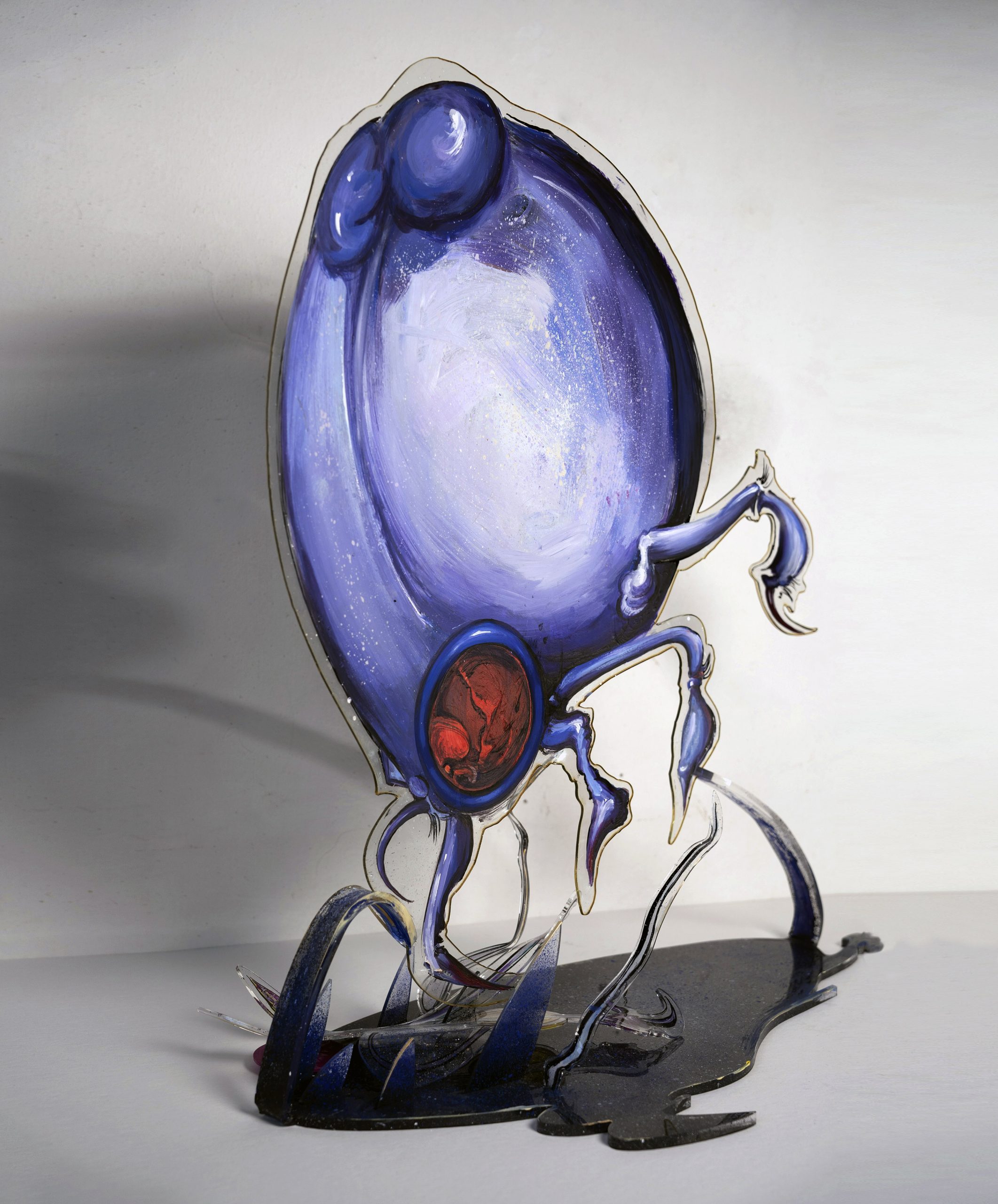
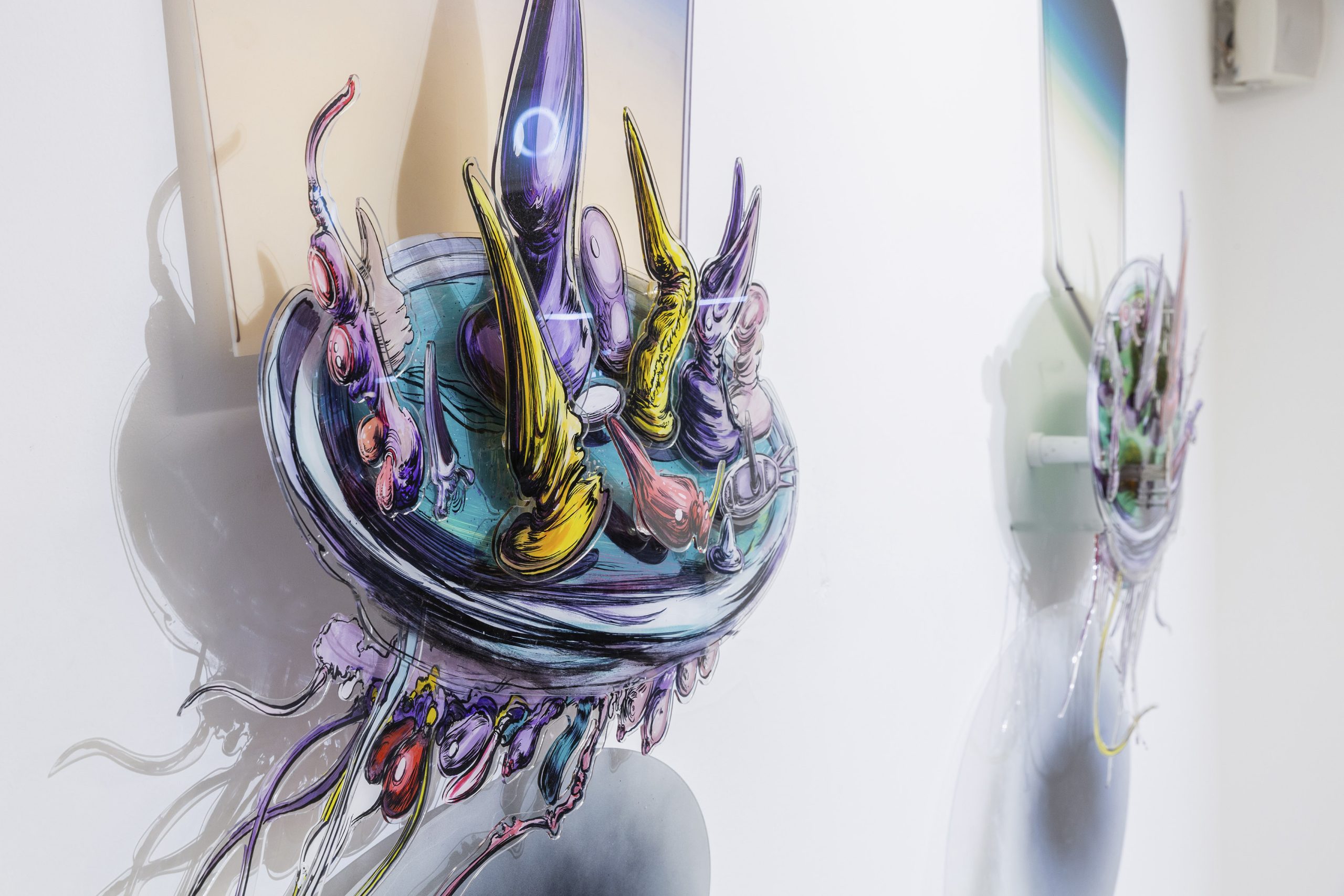
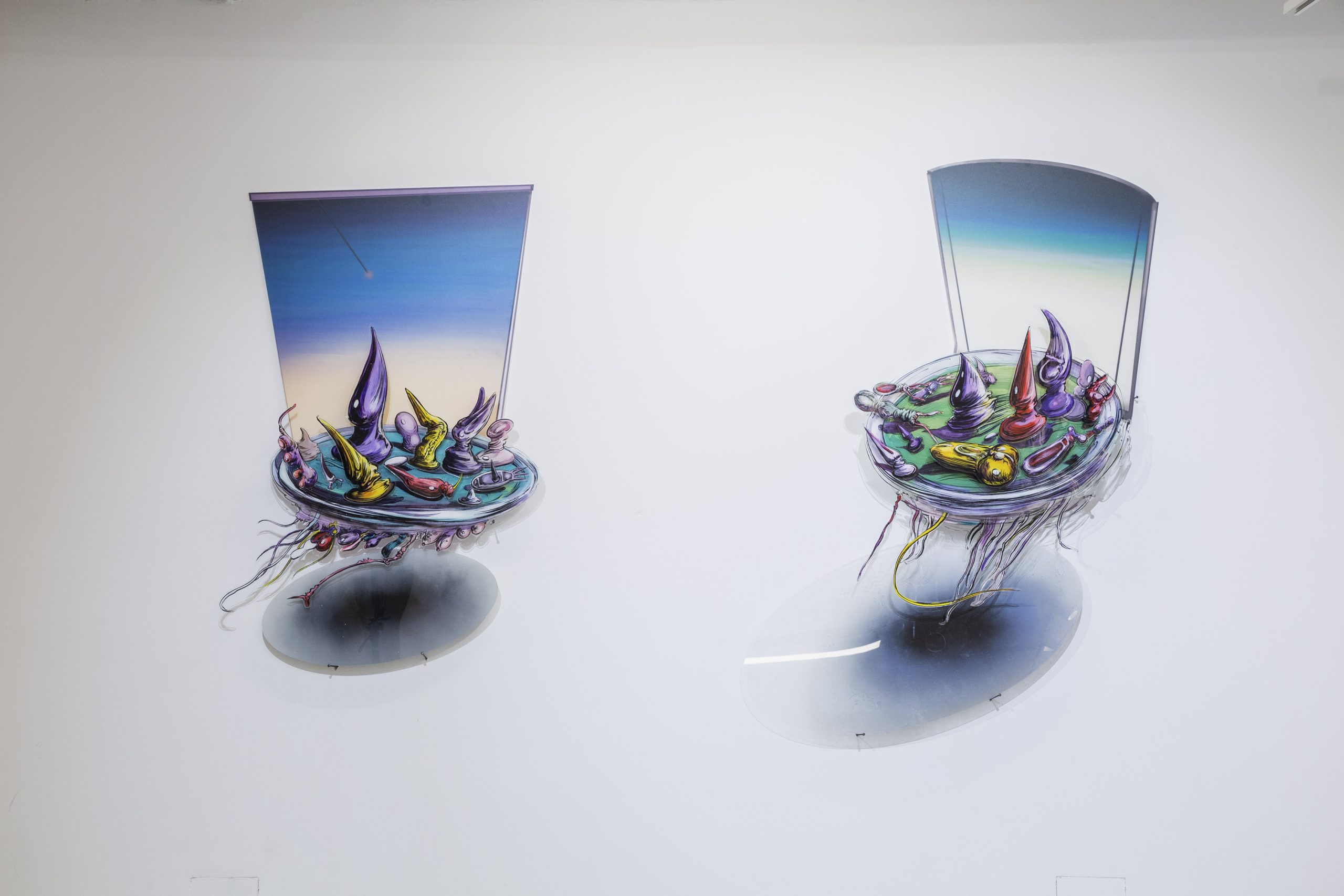
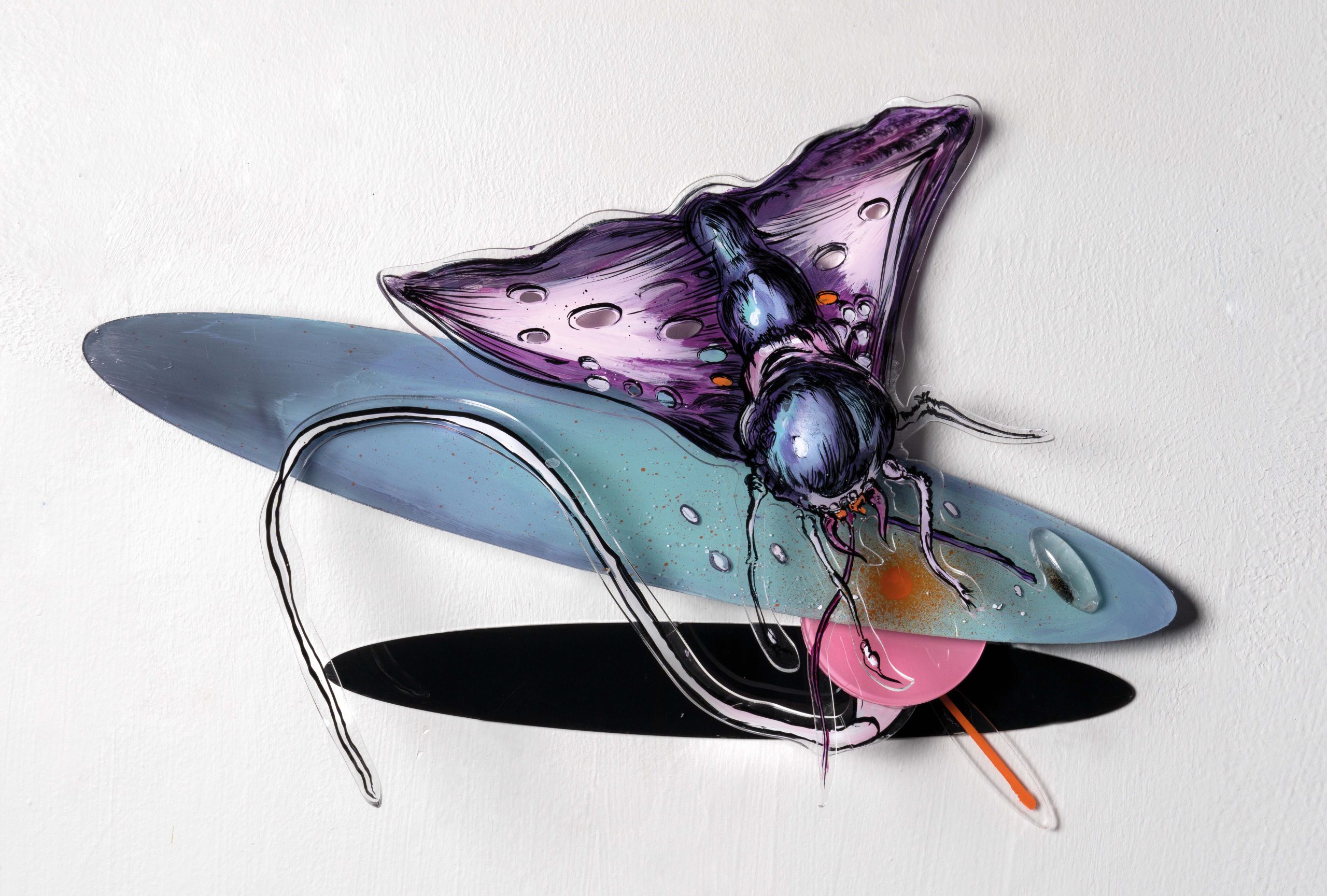
When we step into the world of Vladimir Lalić, among the shapes, lines, colors, and forms that seem somewhat familiar, we are offered the possibility of inquiry: how is the story told, who are the artist’s “beings,” what kind of space do they inhabit, and what can the observer—and, optionally, the active participant—expect? As a devoted reader and observer writing these words, and as Vladimir Lalić creates, we both attempt to detect the spirit of the times and present some possible interpretations of what a person can do today, how they can live their time, how they can perceive, problematize, and reflect upon it. Considering that we are witnessing the state of transhumanism and living beyond human values, a significant turning point arises with the emergence of technology as the decisive force of the modern world. Yet, even though humanity has learned to successfully perform all its tasks, in this time of general crisis and anomie, there is a recurring need for solid anchors and frameworks of orientation. Is it so: does reducing a person to an object or a machine devoid of free will and spiritual dimension represent a degradation of the very essence of human nature? Vladimir Lalić demonstrates that the human dimension is not lost but redefined and viewed from a different perspective. Thus, people do not become automatons or mechanical constructs; instead, through the world of image/drawing/play, they come to know—or at least begin to awaken to—the fact that this is what they essentially are and perhaps always have been: bacteria, moths, flies.
In the process of stylization, the relationship between the physical structure of constructed artistic objects and their theatricality takes on significant importance on one hand, and on the other, the earthly spaces and spatial shaping of life events. We witness the birth of an entirely new metaphysics—the metaphysics of virtual hypersensitivity. The paradox of the moment in which we live entails this strange transformation of superficial quasi-humanism into an increasingly prevalent nihilism. In our world, the body has ceded its place to technology—technology as the basis of mechanical simulacra. All of this contributes to a vast release of instinctive energy: this is the unconscious; and today’s artist returns to their world all possible aspects of exploring the unconscious.
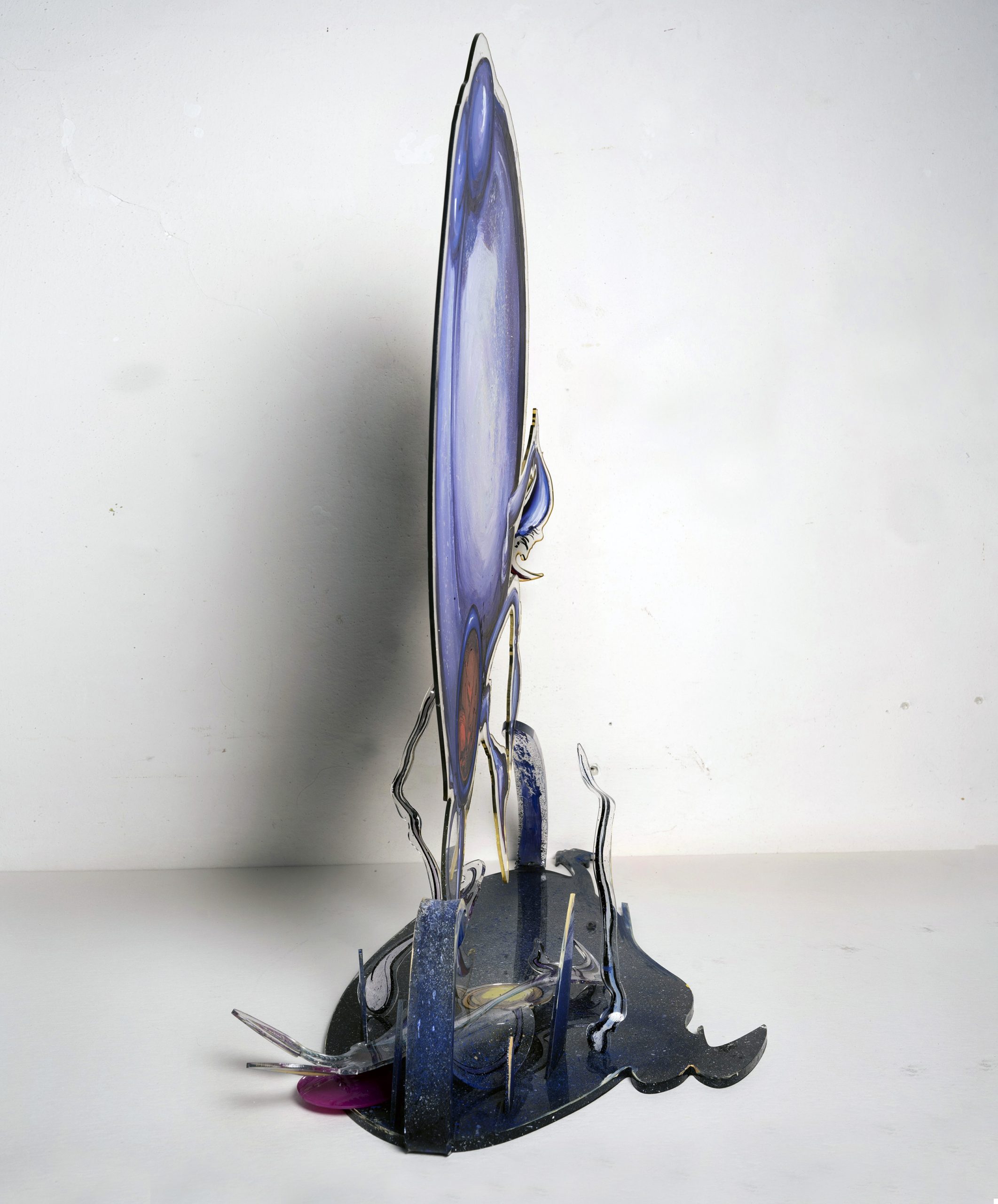
Moreover, Vladimir Lalić portrays all the changes in communication and the testing of the boundaries of the “body” and the gaze of his “creatures” in space, which we as observers are invited to experience most directly, with all our senses. We see them but are unsure whether we are in the lower earthly layers, have ventured deep beneath the ocean, or are floating in celestial expanses. Through luminous elements, the refraction of layers, and through drawings and installations, we arrive at images—of both the inner space and what is experienced externally; seven days lived through the creation and fragmentation of a world, days seemingly repetitive, presenting an entire series of images of microorganisms, persistent in every pore of the knowable and unknowable world, of stories, of dreams. You are free to name Lalić’s world however you wish because it leaves room for the first breath when you abandon the warm waters of safety, when you glide through that feeling, never quite reaching understanding. We remain in the depths, almost subterranean, arriving at a source of life that is still unknown, hidden. We are born, we awaken, and it is possible to return. There is an irreparable discontinuity between the knowledge of hearing and the faithful representation of life itself. The thought is present, the attention fragmented, every feeling and perception, even action itself, incomplete. Time flows in leaps, leaving empty atemporalities in waves that calm, in moments resembling lava pouring from a distant volcano.
What arrives lacks what was meant to come; what has arrived contains what is irretrievably lost. What we have barely glimpsed or intuited hides away, and we do not know where, nor whether it will ever return—that barely opened fissure in the air.
As our steps progress through the gallery space, alongside these micro-changes, we will become aware not only of our own uncertainty but also of the dissipation of time, to the extent that we will no longer be able to discern whether it is morning or evening, whether we are in the past, present, or future. As we no longer live in a serene present but are constantly straining to better prepare for the next day or the future, the question arises of how we will adopt or reflect upon what we have learned, and whether we will see bodies, the hands we touch, and the hands that touch us in the same way. What will be inscribed in the content of our being after encountering Lalić’s world? What expanses will it take us to, what will it decompose us into?
How can we capture that second—the convulsion of birth, or the flicker of dismemberment and reassembly, and transcendence? Will we wait for the Eighth Day, which lies at the transition to the final transformation? However, as the Eighth Day never arrives, and we remain in a tense anticipation that the installations will take flight, the drawings will speak, or simply dissolve, time disintegrates, deconstructed by our engagement of the body. Even if we entered the gallery space aware of our engagement with the world and the precise structure of living and performing everyday tasks, we now find ourselves ensnared in the web of our own—or Lalić’s—thoughts, entirely stripped of freedom. This is precisely the transitional moment in which the artist seeks to guide us to observe the place from where he started and where he arrived. Beyond that, it is up to us to consider whether a single step forward can be taken.
In this sense, the artist’s intention is not to imitate, interpret, or analyze the world but to create alternative worlds in search of answers to the question of what the world is at all, as well as what happens if the boundaries of alternative worlds disappear. By opening the doors of his subconscious and exposing himself, he offers us the opportunity to sense what we are, what we have been, or what we will become. Thus, the dilemma of whether it concerns the past, present, or future ceases to matter, as does the realization that the boundaries of human perception shift and open, striving to provide the most comprehensive picture of reality. Spaces of past solitudes, spaces where the artist suffered or rejoiced, remain within him indelibly. He thus covers space with lived images and states. These images need not be accurate. It is enough for them to be colored as his inner space. The space calls for action. The story of the artist’s beings here is connected with the game of spatiality. It is the space that surrounds the artist and in which he moves. Nothing beyond that is necessary for him to humanize a world. The artist has gone to the edge of experience and lived these images from the other side, while we, from the outside, come to awareness of the restlessness of being.
Finally, we cannot even begin to guess what a person might recount if they were to describe all the doors they have closed, opened, or wished to open again. But is the being that opens certain doors and the one that closes them ever the same? How deep within the being can those movements go that provide a sense of security or freedom? What is the nature of the world we inhabit? Is it the algorithm of some machine or the algorithm of our thoughts?
Having constructed a world where distinctions between the living and the non-living, the possibilities of control and its illusion, truth and falsehood, are blurred, Lalić’s beings are presented as mechanical constructs, chaotically breaking through the mass of incomplete information and half-truths in a desire to reach self-definition or any meaning in the world that surrounds them. Their inability to achieve this, causing them to endlessly circle within an enchanted and closed loop of ignorance, creates an atmosphere of absurdity—a mood that greatly resembles dystopian visions of the future.
In such a chaotic and disoriented world, defined by informational entropy and the accumulation of incomplete, self-reproducing data, the search for truth remains in the realm of creation and play. Play becomes the only remaining repository of knowledge, a kind of parallel world, and the only place from which one can escape the closed loop to answer or at least glimpse answers to the fundamental questions of human existence. Lalić’s world is something that is yet to come, or something that already is and perhaps always has been. It is up to us to decide whether we will surrender to the peculiar governance of the “regime of knowledge and gaze” or focus on some detail out of focus, allowing intuition to prevail, recalling expanses, and joining outlines, surges, and waves of ecstasy, cries, and orgasmic exclamations—of both life and death. One thing is certain: at some point, we will meet.
Jelena Vukicevic